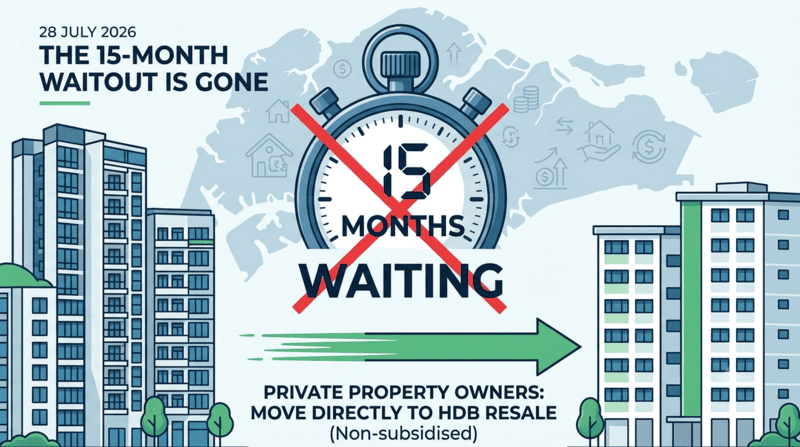
For nearly four years, one rule quietly reshaped how private homeowners planned their exit. Introduced in September 2022, the 15-month wait-out period required a private residential owner to sell, then wait 15 months, before buying a non-subsidised resale flat. Citizens aged 55 and above moving to a 4-room or smaller flat were exempt. Everyone else waited — or rented.
That rule is now gone. Private property owners of all ages can move directly from a private home into a non-subsidised HDB resale flat of any size.
What changed, and what did not
Understand where the boundary sits, because this is where most people will get it wrong.
Removed:
- The 15-month wait-out for buying a non-subsidised HDB resale flat, for private property owners and ex-private property owners, at any age, for any flat size.
Still applies:
- The 30-month wait-out if you intend to buy a subsidised flat.
- You cannot take an HDB housing loan for a non-subsidised resale purchase under this route — bank financing only.
- All standard eligibility conditions: citizenship, family nucleus, ethnic quota, and the requirement to dispose of the private property within six months of completion.
So the correct framing is not "cooling measures are being unwound." The correct framing is: a temporary measure has been retired because it met its purpose, and the safeguards around subsidised housing remain fully intact.
Why now — read the numbers
The Government did not move on sentiment. It moved on supply.
The HDB Resale Price Index fell 0.3% in Q2 2026, after a 0.1% dip in Q1 — a cumulative decline of 0.4% across the first half. That is the first back-to-back quarterly decline in close to seven years. Compare that against the 2.5% jump in 1H 2025 and the 2.7% quarterly surge in Q3 2024, and the trajectory is clear: momentum has flattened.
The supply pipeline explains it. Around 13,500 flats reach their Minimum Occupation Period in 2026, rising to roughly 15,000 in 2027 and 19,500 in 2028. On top of that, HDB is launching close to 7,960 BTO flats in the October 2026 exercise. When you put three years of MOP supply next to a stabilising index, the wait-out period stops doing useful work.
What this means for you — by profile
If you own a private property and want to right-size: your timeline just compressed by 15 months. Previously the sequence was sell → rent for 15 months → buy. Now it is sell → buy. That removes 15 months of rental outlay, one additional move, and one exposure to a moving resale market. On a $6,000/month rental, the saving alone is roughly $90,000 before you count moving costs and market risk.
The trade-off to run properly: you cannot use an HDB loan. Bank financing at current pricing is competitive — but your loan tenure will be capped by age, and TDSR at 55% still binds. Run the actual instalment before you commit to the plan.
If you are holding a private property and were waiting to sell: the barrier to your exit has been removed, but so has the barrier for everyone else in the same position. Expect more of these owners to enter the resale market as buyers over the coming quarters, particularly for larger flats and executive units in mature estates. If you are a seller of a well-located 5-room or executive flat, your buyer pool just widened.
If you are a first-time HDB resale buyer: this is the honest part. Competition for the specific segment that right-sizers want — larger, well-located, newer flats — will firm up. It will not lift the whole index. The affected group has always been a small slice of total resale volume, and the supply wave running to 2028 remains the dominant force. But in the segments where these two buyer profiles overlap, you will feel it.
If you were counting on rental demand: private owners who previously had no choice but to rent for 15 months now have one. That removes a slice of demand from the larger-unit rental market. Landlords holding 3-bedders and above should factor this into renewal expectations.
The positioning read
Taken together with the executive condominium framework revision in May and the ABSD timeline adjustments for large en bloc redevelopments announced the same day, the pattern is consistent: the Government is moving segment by segment rather than across the board. Targeted adjustment, not broad relaxation.
For anyone planning an asset progression move, this is the practical implication — the sequence, the financing route, and the timing gap between your sale and your purchase all need to be recalculated from today's rules, not from the rules you planned around last year.
The 15 months you were budgeting for no longer exists. What you do with that 15 months is now a decision, not a constraint.
If you are holding private property and weighing a right-sizing move, the numbers are specific to your CPF position, outstanding loan, age, and target flat type. I run this as a proper calculation — sale proceeds, CPF refund with accrued interest, cash-out position, and the financing gap — so you can decide on figures rather than headlines. Would you be open for a discussion?
Eric Lee · TheMarketPlace, PropNex Realty
Your Preferred Real Estate Partner
