Most owners never read the developer side of the stamp duty regime. You should — because it determines whether anyone is willing to bid for your estate.
The mechanics, briefly
A licensed housing developer buying residential land pays 40% ABSD. Of that, 5% is non-remittable — a hard cost, always. The remaining 35% is remittable, but only if the developer meets three timelines: commence construction, complete the development, and sell every unit within the prescribed windows.
Miss the window, and the 35% is clawed back with interest. On a large site, that is a nine-figure exposure. Which is exactly why developers price that risk into what they are willing to pay you.
What changed
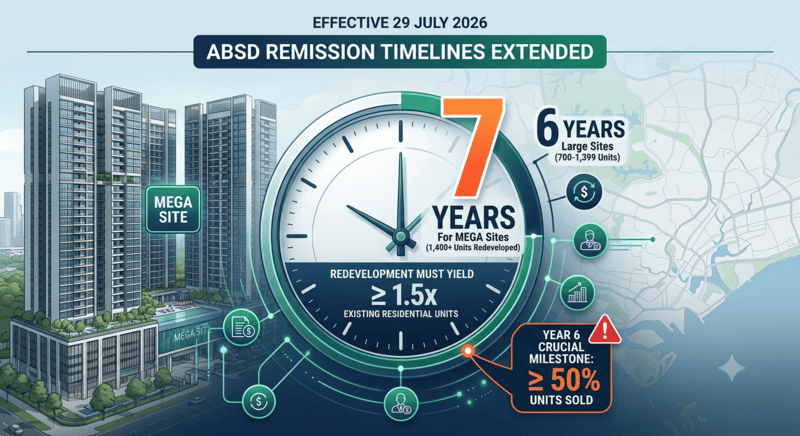
Large en bloc sites are now split into two categories, based on how many residential units the redevelopment will yield.
Category 1A — Large Sites (700 to 1,399 units): completion and sale timeline extended to six years, up from 5.5 years.
Category 1B — Mega Sites (1,400 units and above): completion and sale timeline extended to seven years, up from 5.5 years. The condition: at least 50% of residential units must be sold by the end of year six, or the full 35% clawback applies with interest.
Both categories require the redevelopment to yield at least 1.5 times the number of residential units in the existing development. The commencement timeline stays at 2.5 years for both.
There is a further layer. Under the ABSD Remission Timeline Extension Framework for Complex Projects introduced in March 2025, projects qualifying under more than one category receive an additional six months on top — taking Large Sites to 6.5 years and Mega Sites to 7.5 years, with commencement extended to three years. Mega Sites under that extension must still hit the 50% sales milestone by year six.
Why this is a signal, not a technicality
Read the 1.5x density condition together with the extended timelines and the policy intent is unmistakable: the Government wants ageing, low-density large estates redeveloped into meaningfully higher unit counts, and it is prepared to de-risk the timeline for developers who take that on.
For owners, the practical translation is straightforward. The single biggest reason large collective sales fail is not price disagreement among owners — it is that developers will not underwrite the absorption risk on a 1,000-plus unit launch inside a 5.5-year window. Stretch that window, and the risk premium the developer builds into its bid comes down. A lower risk premium means a higher bid, or a bid where there was none before.
Who this affects
If you own in a large, older development with significant unrealised plot ratio — the kind of estate where en bloc talk surfaces every few years and never gets past the committee stage — the arithmetic on your site has just improved.
That does not mean a sale is coming. It means the developer's model changes. Three things determine whether your estate transacts: unrealised plot ratio, the reserve price your owners can agree on, and whether a developer can build and sell within the timeline without eating the ABSD. The third variable just moved in your favour. The first two are still yours to manage.
The sober counterpoint
Timeline relief is not demand creation. A mega site still has to sell 50% of its units by year six, and that milestone is now an explicit tripwire rather than a soft target. Developers will read that as a discipline, not a licence. Expect them to remain selective — favouring sites with strong location fundamentals and realistic reserve prices over sites where the extension is the only thing making the numbers work.
If your estate's committee is preparing for a collective sale attempt, this is the moment to revisit the feasibility study with the new timelines modelled in. A reserve price set against the old 5.5-year assumption may now be understating what the site can support — or, just as importantly, may still be overstating it. Only the calculation tells you which.
If you own in a development where en bloc discussions are active, or you are assessing whether your estate has the density profile to attract a developer, I'm happy to walk through the feasibility numbers with you. No obligations.
Eric Lee · TheMarketPlace, PropNex Realty
Your Preferred Real Estate Partner
