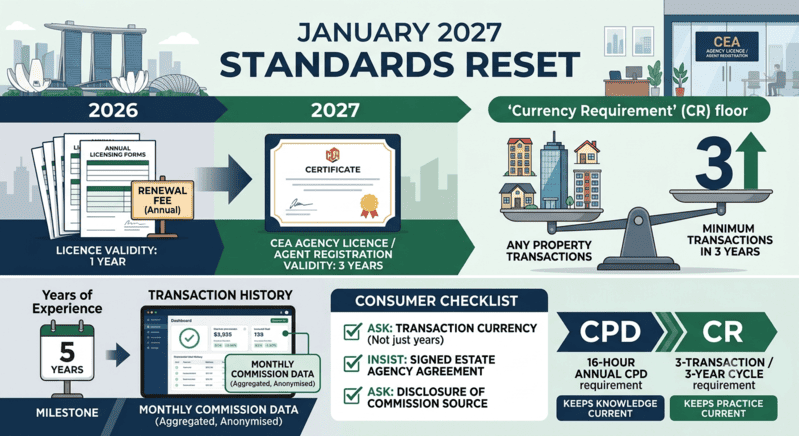
There were 38,162 registered property agents and 1,018 agencies in Singapore as at 1 July 2026. From January 2027, how they stay registered changes.
The three near-term measures
1. Licence validity moves from one year to three years.
From 1 January 2027, agency licences and agent registrations will be valid for three years instead of one. The renewal exercise at the end of 2026 kicks off the first cycle, running 1 January 2027 to 31 December 2029. Fees are still charged annually — so no large lump sum at renewal — but the application fee is only paid once per cycle.
2. A new Currency Requirement (CR).
To renew for another three years, an agent must either complete at least three property transactions across the three-year cycle, or pass a Refresher Examination.
The transactions that count are broad: HDB resale and rental, private residential sale, resale and rental, commercial sale, resale and rental, industrial sale, resale and rental, foreign property sales, and en bloc transactions.
The exemptions are sensible. New agents are not required to complete any transactions in their first year — they meet the CR from year two, meaning two transactions across the remaining two years, or the Refresher Exam. Waivers may be considered case-by-case for extenuating circumstances such as serious medical issues, or for agents handling complex transactions that legitimately take longer to close. Anyone in a management role not conducting estate agency work does not need to maintain registration at all.
Anyone who does not hit three transactions is guaranteed a seat at the Refresher Exam. CEA will publish details by the first half of 2029.
3. Commission data collection.
From 1 January 2027, CEA will collect commission data from agencies monthly. Individual agents' figures will not be published. The intent is to eventually publish aggregated, anonymised industry-level data so prospective agents get a realistic picture of the career before they enter it.
The number that explains all of this
In CEA's 2024 Public Perception Survey, three in four consumers said they expect their agent to complete at least one transaction a year. About 40% of agents do not meet that expectation today. From 2023 to 2025, the median agent completed two residential transactions per year.
Read that again. The median. Two a year.
The CR is set at three transactions over three years — one a year. That is not a high bar. It is a floor. And the fact that a floor was necessary tells you something about the distribution of activity in a 38,000-agent industry.
What is under study
Eight longer-term measures are being consulted on. Several will matter to consumers directly:
- A full-scale listing verification platform launching next year, to tackle inaccurate, fake, duplicate and unauthorised listings.
- Publishing consumer ratings of agents on the CEA Public Register, and making the register easier to access.
- Requiring a signed Estate Agency Agreement and disclosure of who the agent is collecting commission from before work commences.
- Making HDB's Resale Flat Listing the default listing platform for HDB resale flats, and studying whether consumers can list directly on property portals.
- A survey of agents on how well their agencies support them.
What this means if you are engaging an agent
Three practical takeaways.
One: ask about transaction currency, not just years in the industry. "Fifteen years in real estate" and "closed a transaction this quarter" are different claims. From 2027, the regulator is effectively asking the same question. You can ask it now.
Two: insist on a signed Estate Agency Agreement. CEA is studying making this mandatory precisely because unsigned engagements produce downstream disputes over scope, duration and commission. A signed agreement protects you more than it protects the agent — it defines exactly what you are getting and who is paying for it.
Three: ask who is paying the commission. Dual representation and undisclosed commission sources are among the most common complaints CEA receives. The disclosure requirement under study exists because the question is not always asked. Ask it.
What this means if you are in the industry
I lead a team of 15. My honest read: this is good regulation.
An industry where 40% of practitioners fall below the consumer's minimum expectation has a credibility problem, not a licensing problem. A one-transaction-a-year floor does not threaten anyone who is genuinely practising. It removes the ambiguity for consumers who cannot tell the difference between a registered agent and an active consultant.
The commission data collection is the piece the industry will find uncomfortable, and it is the piece that will do the most good. Recruitment in this business has been sold on the ceiling for years. Publishing the distribution — aggregated and anonymised — lets people enter with their eyes open. That is a healthier industry, not a smaller one.
The 16-hour annual CPD requirement, in place since 1 January 2026, continues alongside all of this. CPD keeps your knowledge current. The CR keeps your practice current. Both are needed.
The rules are changing, but the standard was never set by the regulator — it was set by whether your consultant can show you the calculation. If you want a second opinion on a property decision, with the numbers laid out, no obligations, I'm happy to have that conversation.
Eric Lee · TheMarketPlace, PropNex Realty
Your Preferred Real Estate Partner
