The data
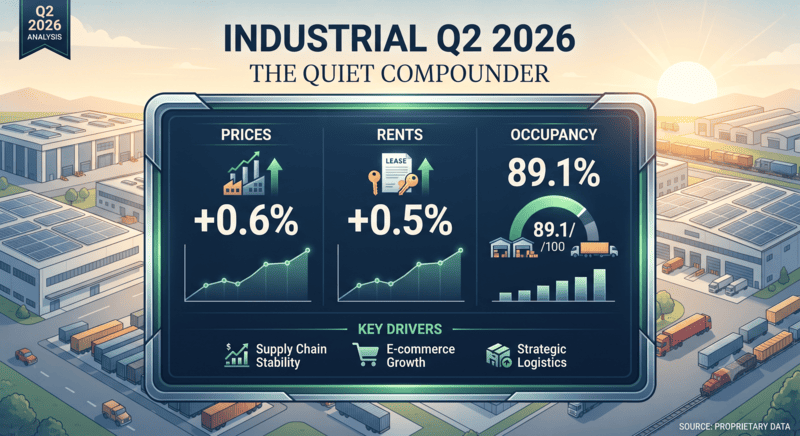
JTC's Q2 2026 figures:
- Price index: 113.8, up 0.6% QOQ and 3.8% year-on-year
- Rental index: 113.8, up 0.5% QOQ and 2.1% year-on-year
- Islandwide occupancy: 89.1%, up from the previous quarter
Both indices are based at 100 in Q4 2012. Total industrial stock stands at roughly 54,532 units-worth of space across multiple-user and single-user factories, business parks and warehouses.
JTC also revised rental rates for industrial land and ready-built facilities for 2H 2026, effective 1 July.
What these numbers describe is a market that grinds upward. No spike, no correction. Prices up 3.8% year-on-year, rents up 2.1%, occupancy improving. For an income asset, that is the profile you want.
Why industrial behaves differently
Three structural reasons.
One — tenure defines the asset class. Most industrial stock is leasehold, frequently 30 or 60 years from JTC or on shorter balance terms. Freehold industrial is genuinely scarce, and that scarcity commands a premium that has widened as the leasehold pool ages. When I assess an industrial asset, remaining tenure is the first number I look at, before psf.
Two — the buyer pool is different. Industrial buyers are typically owner-occupiers with a business need, or investors underwriting a yield. Neither group buys on sentiment. That is why the index moves in tenths of a percent rather than whole points — and why it rarely gives back what it gains.
Three — no ABSD, no SSD on industrial. Unlike residential, there is no Additional Buyer's Stamp Duty on industrial property, and Seller's Stamp Duty applies on a separate, shorter schedule for industrial than for residential. That removes a substantial friction cost from the entry and exit maths. It is one of the main reasons investors who have hit their residential ABSD ceiling move into this segment.
How I underwrite an industrial deal
Six figures, in this order.
1. Remaining tenure. A 60-year leasehold with 38 years left and a 60-year leasehold with 55 years left are different assets, not different prices of the same asset. Financing tenure, buyer pool at exit, and depreciation curve all key off this number.
2. Allowable use and zoning. B1 versus B2 determines what a tenant can legally do in the unit, and therefore your realistic tenant pool. B1 supports light industrial and clean use; B2 permits heavier operations with buffer requirements. A unit marketed as suitable for a use it is not approved for is a valuation problem waiting to happen. Check the approved use, not the marketing copy.
3. Floor loading, ceiling height, and access. These are the specifications that determine whether an operator can actually use the space. Adequate floor loading and clear ceiling height, plus loading bay and lift access, widen your tenant pool substantially. Weak specifications narrow it — and a narrow tenant pool shows up as void periods.
4. Gross yield against net yield. The asking yield you are quoted is almost always gross. Deduct property tax, maintenance and sinking fund, management, insurance, and a realistic vacancy allowance. On multi-user industrial, the gap between gross and net commonly runs 0.8 to 1.2 percentage points.
5. Reversion risk on the existing tenancy. What is the passing rent versus current market rent? A unit let above market on a tenancy expiring in twelve months carries a downward reversion you are being asked to pay for today. A unit let below market carries embedded upside.
6. Cost of debt against net yield. With commercial and industrial financing currently available at historically low levels, the spread between net yield and cost of debt is unusually wide. That is genuinely attractive — provided you stress-test it. Model the deal at a materially higher cost of debt as well. If it only works at today's rates, you are taking a rate position, not a property position.
Where I see value
Freehold B1 in established estates with genuine transport access continues to be the strongest risk-adjusted profile — the scarcity premium is structural and the tenant pool is broad. Newer multi-user B2 with proper specifications also holds up where the operator demand is real.
What I would be careful with: short-balance-lease multi-user units where the financing tenure is compressed and your exit buyer pool shrinks every year. The yield often looks attractive precisely because the market is pricing a real problem.
Industrial is a calculation business — tenure, use, specification, and net yield. If you are looking at a B1 or B2 unit, I'll build the full model before you commit to a number, including the reversion and the stressed financing case. No obligations.
Eric Lee · TheMarketPlace, PropNex Realty
Your Preferred Real Estate Partner
