The office numbers
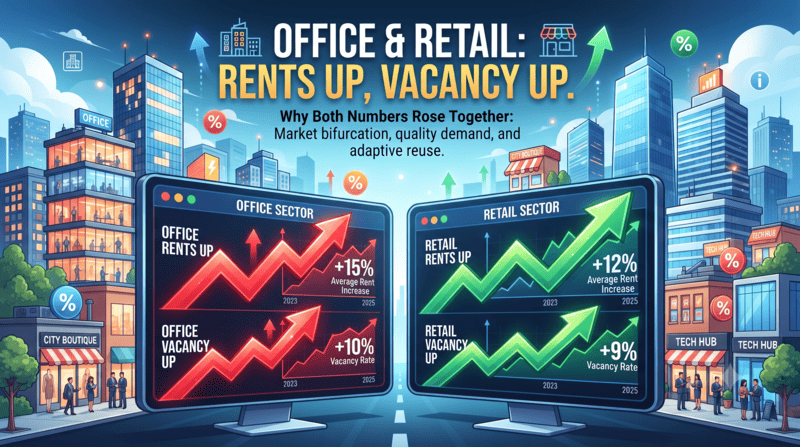
Office rents rose 0.4% QOQ in Q2 2026, following a 0.2% rise in Q1. Prices rose 0.8% QOQ, reversing a 0.2% decline the previous quarter.
At the same time, islandwide vacancy rose from 10.8% to 11.0%, and islandwide occupancy slipped 0.2 percentage points from 89.2% to 89.0%.
Occupied office space grew by about 86,111 sq ft in the quarter — well down from 279,862 sq ft in Q1. Stock grew faster, by 204,514 sq ft. More space arrived than was absorbed. Hence the vacancy uptick alongside rising rents.
Forecasts for the rest of 2026: Cushman & Wakefield puts CBD Grade A rental growth at 4–5%, with office rents already up 2.2% in the first half. Knight Frank projects 3–5% growth given tight CBD supply, with decentralised locations picking up spillover when CBD occupiers need lower-cost options for growth.
The retail numbers
Retail prices rose 0.8% QOQ, easing from 2.2% in Q1. Rents rose 0.6% QOQ, reversing a 0.6% decline in Q1.
Vacancy went the other way — up across every submarket. Orchard Road rose from 7.1% to 7.2%. RCR reached 8.3%, OCR 5.2%. Occupied retail space fell by about 398,265 sq ft in the quarter, against an increase of 64,584 sq ft in Q1.
Forecast: Knight Frank projects retail rents growing approximately 2–4% through the rest of 2026.
F&B accounted for 53% of new prime mall openings in 1H 2026, with lifestyle at 16% and fashion at 14%. New international entrants continue to arrive even as established operators close outlets under cost pressure.
Why rents and vacancy rise together
Because the market has split into two tiers, and the index reports the sum.
In office: flight to quality. Occupiers renewing out of necessity rather than expanding are still competing hard for well-located, newer Grade A space with sheltered connectivity to transit. That competition holds rents up. Meanwhile older buildings with obsolete specifications and poor connectivity absorb the vacancy. New CBD supply is scarce — Shaw Towers is the only significant completion in 2026 — which is why prime rents keep firming even as the aggregate vacancy number rises.
Two demand shifts worth noting: financial services remains the anchor, but AI firms and start-ups are becoming a meaningful occupier segment, and global instability has reinforced Singapore's position as a safe-haven regional base. Office investment activity has been strong — deals reached a record quarterly high of around $14.73 billion in Q1 2026.
In retail: the same two-tier pattern. Top-tier assets with strong connectivity and curated tenant mixes hold rent; secondary assets carry the vacancy. Landlords with limited new supply in the pipeline are focusing on asset enhancement to unlock value — planned upgrades at City Square Mall, West Mall, Hougang Mall, NEX and Plaza Singapura are all part of this. Ownership changes are accelerating the effect: Paragon's $3.9 billion sale to CICT, Delfi Orchard acquired by CDL for $439 million, the rear block of The Centrepoint, and older Orchard assets like Tanglin Shopping Centre, Ming Arcade and Concorde sold for redevelopment.
Well-located suburban malls with strong residential catchments are expected to lead growth, driven by everyday domestic demand. Orchard expansion is becoming more selective, concentrated in top-tier luxury.
What this means if you are buying strata commercial
Three rules I apply when advising on this segment.
One — buy the catchment, not the building. A suburban strata retail unit with a captive residential catchment and direct transit connectivity is a fundamentally different asset from a similar-sized unit in a secondary central location, even at the same psf. The vacancy data is telling you where the risk sits.
Two — underwrite on the tenancy, not the asking yield. A unit quoted at 4% gross yield on a tenancy expiring in eight months is not a 4% asset. Model the reversion honestly: what does this unit re-let at, to whom, and how long does it sit empty in between? With islandwide retail vacancy at 7.0% and rising, void periods are a real line item.
Three — the financing spread is doing a lot of work right now. With bank commercial financing available at historically low levels, the gap between gross yield and cost of debt is unusually wide. That supports pricing today. Underwrite the deal at a higher rate as well, and see whether it still stands up. If it only works at 1.4% money, it is a rate bet, not a property investment.
And one for owners: if you hold an older, less competitive commercial asset without transit connectivity, the trend is running against you. Rising prime rents will not lift your unit. Either reposition it — tenant mix, fit-out, lease structure — or plan your exit while the investment market is active.
Commercial and industrial is where I do a significant share of my volume, and it is where the gap between the asking price and the defensible price is widest. If you are assessing a strata unit, I'll build the full yield and reversion model before you commit. Would you be open for a discussion?
Eric Lee · TheMarketPlace, PropNex Realty
Your Preferred Real Estate Partner
