Where rates stand
As at late July 2026:
- 3-month compounded SORA: approximately 1.12–1.13%
- 1-month compounded SORA: approximately 1.16–1.18%
- Fixed packages: from roughly 1.35–1.40% on two-year tenures, depending on bank, loan size and property type
- Floating packages: from roughly 1.30–1.32%, commonly quoted as 3M SORA plus a spread of around 0.20%
- HDB concessionary rate: 2.6%, pegged at 0.1% above the CPF Ordinary Account rate
Read that last line against the ones above it. Bank packages are currently pricing below the HDB concessionary rate. That is not the normal state of affairs, and it is the single most consequential fact in this article for HDB owners on an HDB loan.
Both SORA tenors ticked up slightly this month, which suggests rates have found a floor rather than that they are still falling.
What a rate move is actually worth
Take a $1 million loan over 25 years.
At 4.0%, the monthly instalment is roughly $5,278. At 1.40%, it is roughly $3,948. That is about $1,330 a month, or close to $16,000 a year, on the same loan and the same property.
Even a narrower move matters. Coming off 2.6% down to 1.40% on the same loan saves roughly $520 a month — around $6,200 a year.
This is why "I'll look at refinancing when I have time" is one of the more expensive sentences in Singapore property.
The trap: cheapest headline rate ≠ lowest total cost
Four things to check before you chase the lowest number on a comparison table.
One — lock-in period and penalty. A 1.30% package with a two-year lock-in and a 1.5% redemption penalty is not cheaper than a 1.45% package with a one-year lock-in if your circumstances might change. Ask what it costs to leave, not just what it costs to stay.
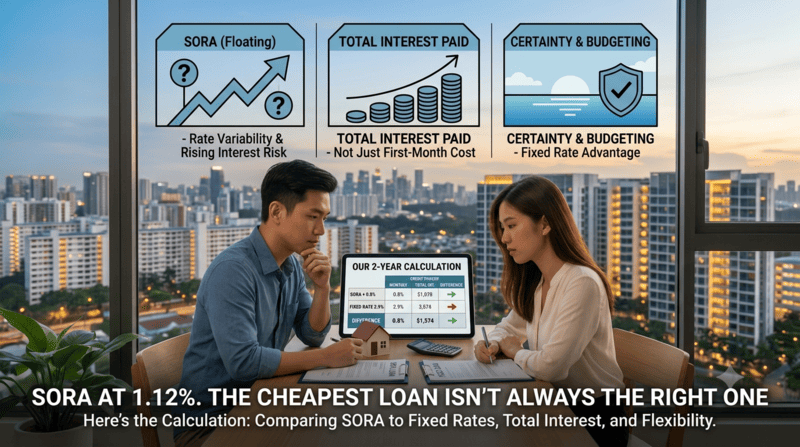
Two — the year-two and year-three rate. Many promotional fixed packages are structured with a low year-one teaser and a step-up after. A "1.30% package" that becomes 1.40% in year two is a different product from a flat 1.35% across both years. Compare total interest over the full lock-in, not the first twelve months.
Three — legal and valuation subsidies, and clawback. Refinancing costs money — legal fees, valuation, sometimes a fire insurance switch. Many banks subsidise these, with a clawback if you redeem within a set period. Net it out against the interest saving to get the real number.
Four — fixed versus floating is a risk decision, not a price decision. The spread between the best fixed and best floating rate is currently narrow — roughly 1.35–1.40% fixed against roughly 1.30–1.32% floating. When the gap is that thin, you are paying almost nothing for certainty. If your household cash flow is tight or your income is variable, fixed is often the correct choice even at a marginally higher rate. If you have buffer and intend to refinance actively, floating keeps the cost lower.
What this changes for buyers
Lower financing cost does not automatically raise your affordability, because TDSR at 55% and MSR at 30% for HDB and EC purchases are assessed using a stress-test interest rate floor, not the promotional rate you are offered. Your borrowing capacity is calculated against that floor.
What lower rates do change is your actual monthly outlay once the loan is drawn — which affects your holding power, your yield on an investment property, and your ability to service a bridging gap during an upgrade.
For investment purchases in particular, this is the variable that decides whether a deal is cash-flow positive. A commercial or industrial unit yielding 4% gross against a 1.4% cost of debt is a different proposition entirely from the same unit against a 4% cost of debt two years ago. That is the arithmetic behind a lot of the commercial and industrial activity in the current market.
The action list
- Check your current rate and your lock-in expiry date. If your lock-in has expired and you are on a rate above 2%, you are almost certainly overpaying.
- If you are on an HDB concessionary loan at 2.6%, get a comparison done — but understand the trade-off. Switching to a bank loan is a one-way door; you cannot switch back to an HDB loan. You also lose the flexibility of the HDB loan's lower cash requirement.
- If you are two to four months from lock-in expiry, start now. Repricing and refinancing both take lead time, and the notice period on your existing package matters.
- Compare across banks, not within one. Rates vary meaningfully by loan tier, with the sharpest pricing typically reserved for larger loans.
Financing structure is half of any property decision and the half most people delegate without checking. If you want your current loan reviewed against what is available today — with the total cost over the lock-in, not just the headline rate — I'm happy to run the comparison and connect you with a banker. No obligations.
Eric Lee · TheMarketPlace, PropNex Realty
Your Preferred Real Estate Partner
Rates quoted are indicative as at late July 2026 and change frequently. Confirm current pricing with the bank before making any decision.
