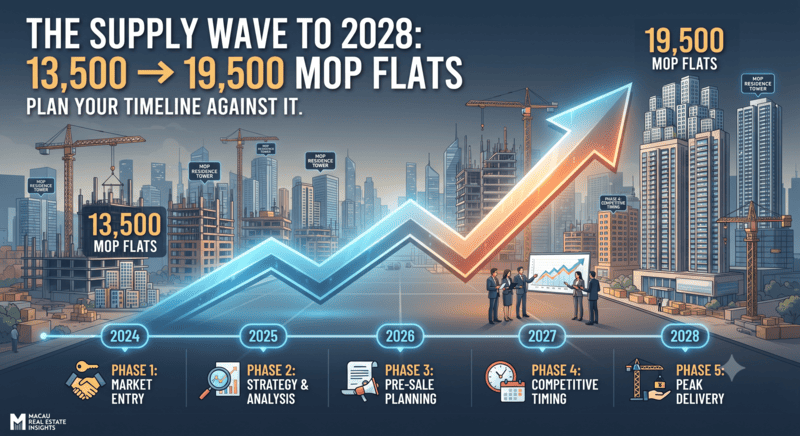
The numbers on the table
Public housing — flats reaching MOP:
- 2026: approximately 13,500
- 2027: approximately 15,000
- 2028: approximately 19,500
BTO supply: HDB launches close to 7,960 flats in the October 2026 exercise, across Bedok, Geylang, Sembawang, Tengah, Toa Payoh and Yishun, plus a Community Care Apartment project in Toa Payoh.
Private housing: 4,745 units on the 2H 2026 Confirmed List, taking the full-year Confirmed List to 9,320 units — over 50% above the ten-year annual average. Around 61,000 private units including ECs are expected to complete over the next few years.
Put together: roughly 48,000 flats reaching MOP over three years, close to 8,000 BTO flats in one exercise, and a private pipeline running half again above its long-run average.
That is the context for everything else that happened this year.
Why the policy moves line up with the schedule
Look at 2026's decisions in sequence:
- 8 May: EC framework revised — 10-year MOP, no DPS, 90% first-timer quota.
- 28 July: 15-month wait-out period for private owners buying non-subsidised resale flats removed with immediate effect.
- 28 July: ABSD remission timelines extended for large and mega en bloc redevelopment sites.
Each of these is a calibration against the supply picture. With HDB resale prices down 0.4% cumulatively in 1H 2026 and the MOP wave building through 2028, the wait-out period had done its job. With private completions running high and large sites needing longer to absorb, the ABSD timeline needed stretching. With semi-subsidised housing under pressure to serve owner-occupiers, the EC scheme was tightened.
This is a Government managing a supply cycle, segment by segment. Expect the calibration to continue in both directions.
What it means for your timeline
If you are selling an HDB flat in the next 12 to 24 months: you are selling into a rising supply curve. The competitive set in your estate expands every quarter as more projects clear MOP. This does not mean prices fall — the index moderating while million-dollar deals set records tells you differently — but it does mean the buyer has more alternatives every month you sit on the market.
The practical implication: your window of best pricing is generally earlier in the wave, not later, and your marketing has to work harder than it did in 2024. Proper positioning, professional marketing, and qualified buyer reach are not nice-to-haves in an expanding-supply market. They are the difference.
If you are buying HDB resale: time is on your side, within limits. More MOP supply and a large October BTO launch means more options and more negotiating room in the middle of the market. But note where that is not true — the record 491 million-dollar transactions in Q2 tells you the well-located, newer, larger flat segment is not softening. If that is your target, waiting does not obviously help you.
If you are upgrading from HDB to private: this is the sequencing problem, and it is now sharper. Your sale side faces expanding supply; your buy side faces a private market that has kept rising, if more slowly. The gap between the two matters more than either number.
With the 15-month wait-out gone, one thing has changed in your favour: if your plan ever involved moving back into a resale flat later, the return path is now open without a wait. That flexibility is worth building into your model.
If you are a private owner considering right-sizing: the calculation changed on 28 July. Sell-then-buy is now a continuous sequence rather than a 15-month gap. But you are moving into the same expanding resale supply as everyone else, and you cannot use an HDB loan on a non-subsidised purchase. Get the financing structure confirmed before you commit to a sale.
The framework I use
For any move in this environment, I run four things in order:
- Proceeds calculation — sale price less outstanding loan, less CPF refund with accrued interest, giving actual cash and CPF position.
- Purchase affordability — against TDSR at 55%, MSR at 30% where applicable, and stress-test rates rather than promotional rates.
- Stamp duty position — BSD on the purchase, ABSD where it applies, SSD exposure on the sale, and any remission or refund route available.
- Timeline — OTP dates, exercise windows, completion dates, and the gap between your sale completion and your purchase completion, with a bridging plan if there is one.
Get those four right and the market moving 0.5% in a quarter barely registers. Get them wrong and no amount of favourable market conditions saves the transaction.
Real consultants calculate. Posters just post.
If you are planning a move within the next two years, the supply calendar should be part of your timing decision — not an afterthought. I'll map your proceeds, affordability, stamp duty and timeline against it so you can move on numbers. Would you be open for a discussion?
Eric Lee · TheMarketPlace, PropNex Realty
Your Preferred Real Estate Partner
